
The Sequence
The free piece told you Morocco's system held. It didn't tell you how close it came to not holding — or the six decisions, some seventeen years old, that made the difference.

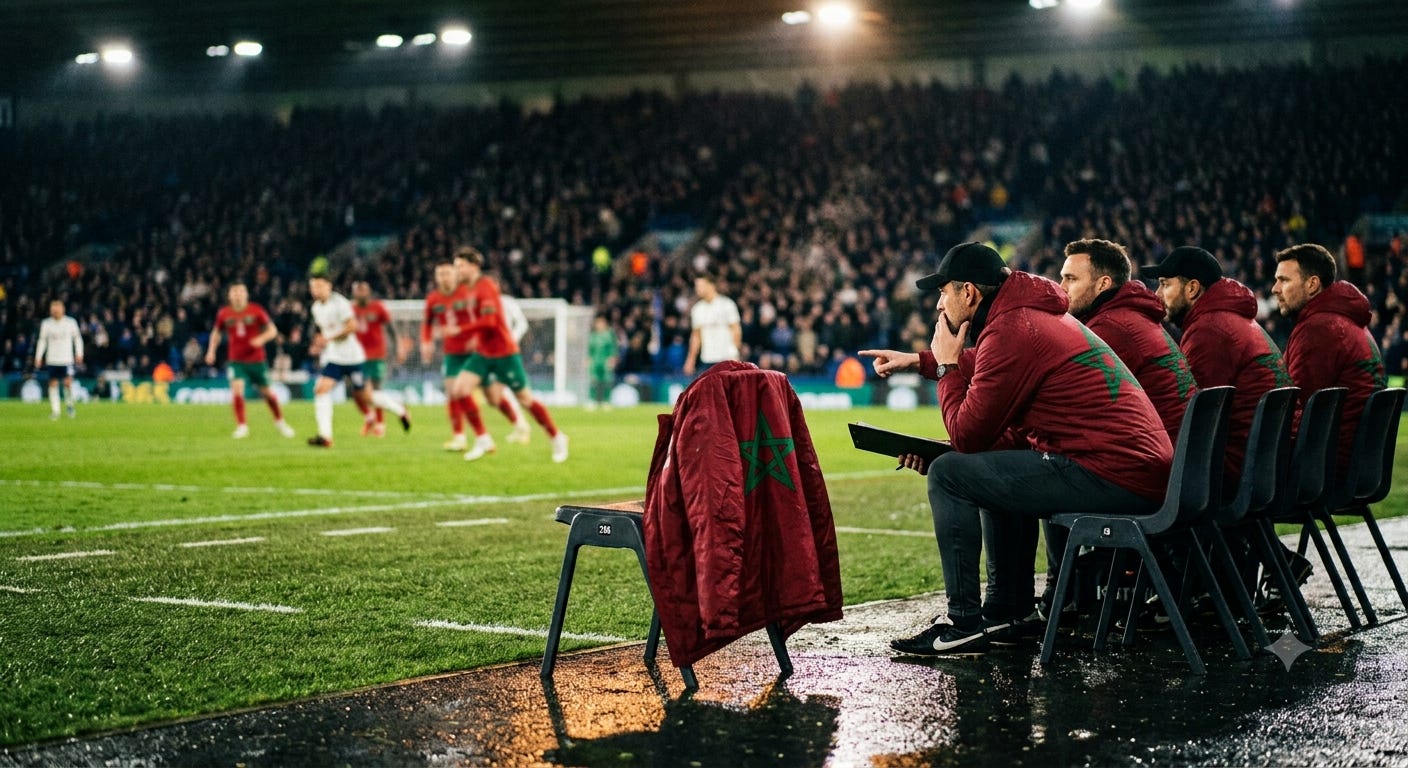
Here’s what the free version left out.
Morocco didn’t cruise through this 2026 World Cup. They finished second in their own group, on goal difference, behind Brazil. Against Haiti, they trailed twice before winning 4-2. Against the Netherlands, they were down 1-0 with nineteen minutes left in regulation. A header in the 91st minute saved them and forced penalties. The whole campaign came down to Yassine Bounou guessing right and Ismael Saibari not missing.
Twice, this “system that held” was about ninety seconds of game time away from being the story of a promising new coach who couldn’t handle the pressure of an early exit.
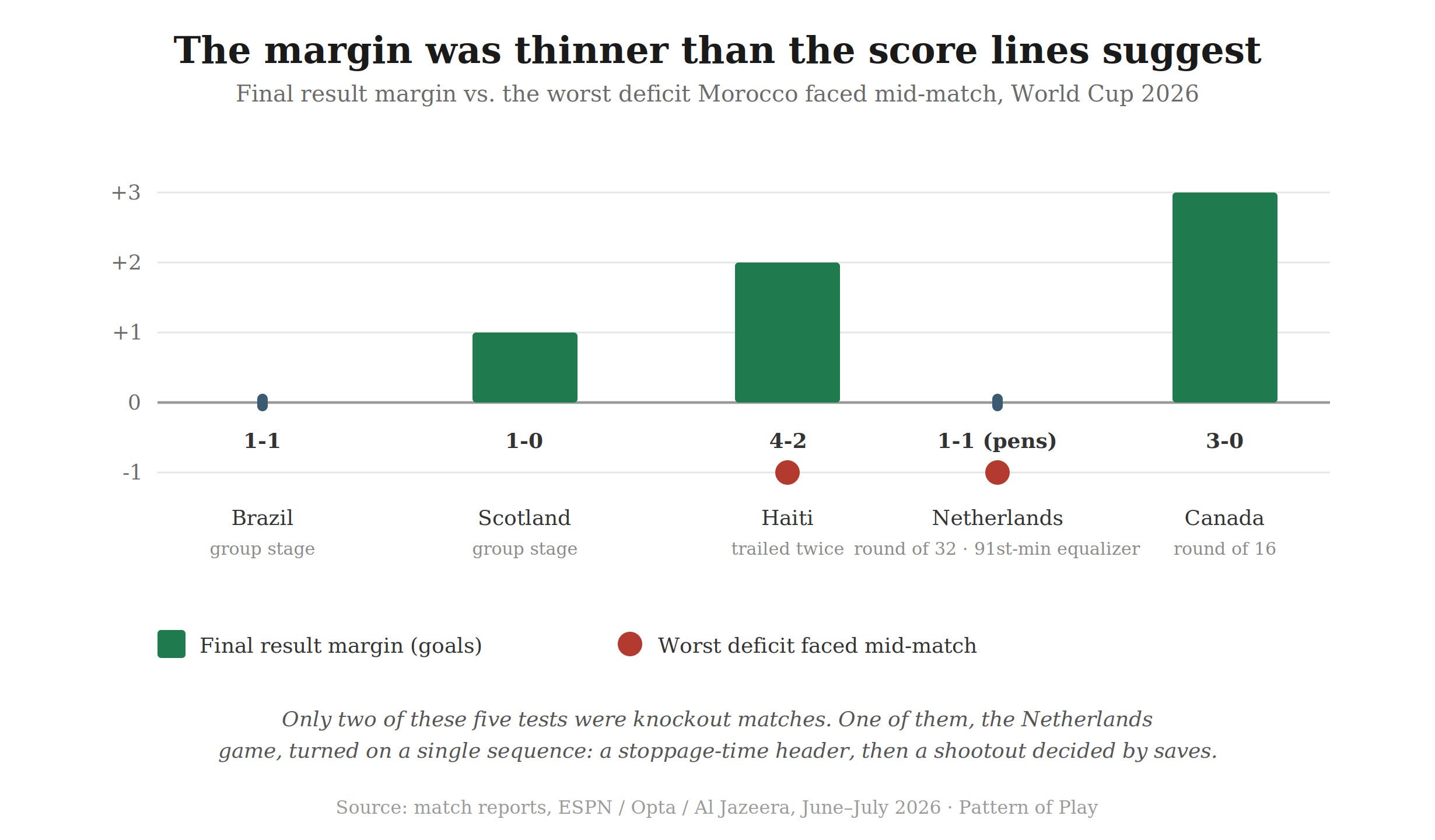
I’m showing you that chart because the clean version of this story — coach leaves, system holds, final score line looks comfortable — is true, but it’s not the useful version. The useful version shows exactly how thin the margin was. It also shows exactly which decisions, made years before anyone knew there would be a crisis, are the reason Morocco was still standing when the margin ran out.
The free piece asked whether your organization would survive your sudden absence. This piece is about the actual mechanism — the sequence of specific, dated, unglamorous decisions that make that kind of survival possible. Not the philosophy, but the sequence. Because a principle you agree with changes nothing. A sequence you can copy might.
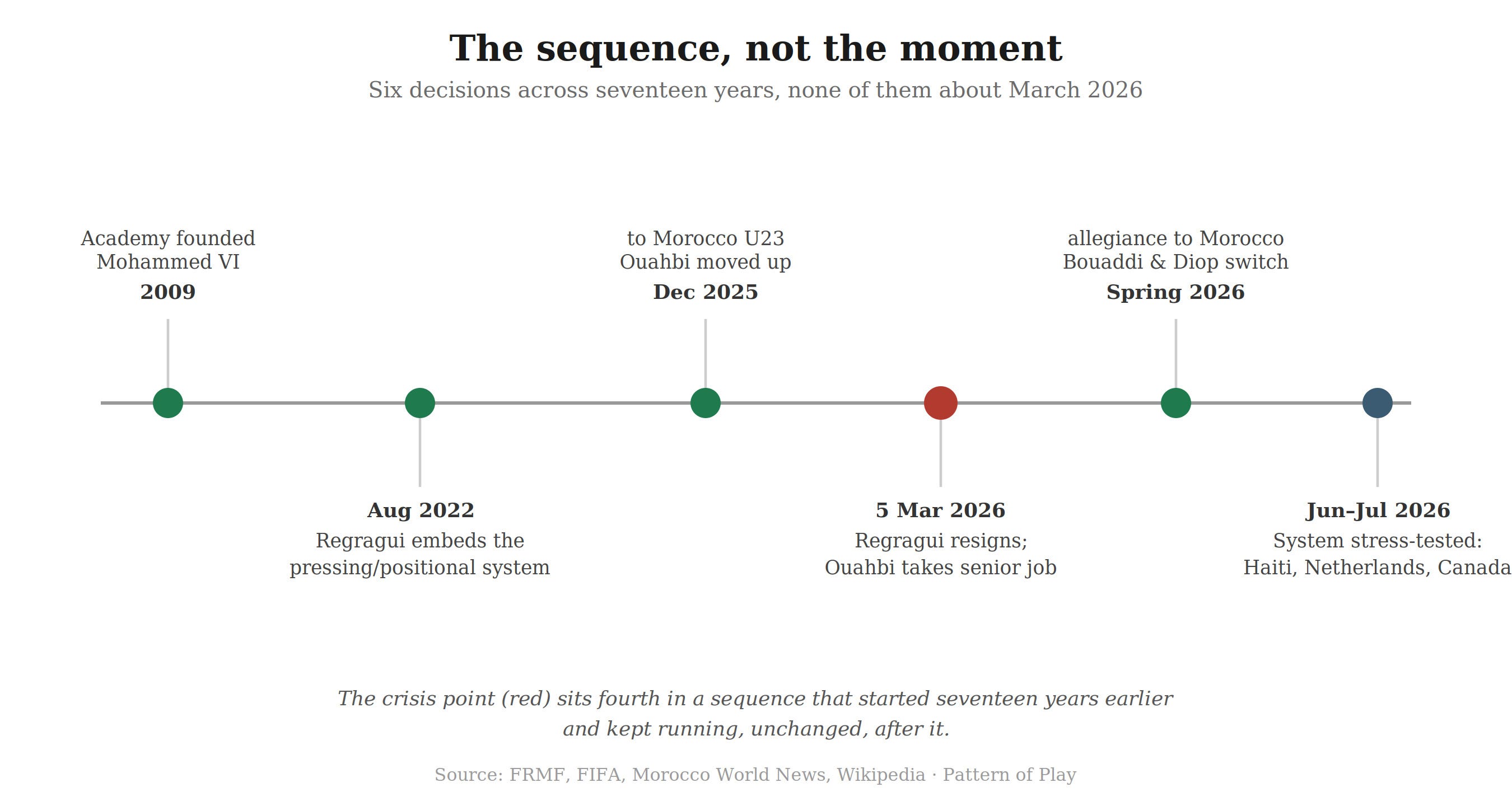
Here it is, decision by decision.
Decision One: Build the credibility before you build the pipeline (2009)
In 2009, King Mohammed VI opened a football academy in Salé with a specific mandate: identify Moroccan players early, and develop them with both athletic and academic training under one roof. Long before anyone was talking about Morocco as a World Cup contender, this was an investment with no guaranteed return. Morocco had reached the knockout stage of a World Cup exactly once before, in 1986.
That patience mattered later, for a reason most talent strategies miss. By 2022, four academy-trained players were in the squad that reached the semifinal in Qatar: Youssef En-Nesyri, Nayef Aguerd, Ahmed Reda Tagnaouti, and Ounahi himself. All four were named directly by the academy’s own recruitment staff at the time. By 2025, Wikipedia and BBC Sport both confirm four academy-trained players started for the Morocco side that won the country’s first-ever U-20 World Cup title. I could only independently confirm one name, though: Yassir Zabiri, who scored both goals in the final and finished as the tournament’s top scorer. Azzedine Ounahi, the player who scored both goals against Canada to send Morocco through at this 2026 World Cup, came up through Raja Casablanca and the academy system, not a European club pathway.
The sequencing point is this: you cannot credibly recruit outside talent into a project that doesn’t yet exist. Morocco built the domestic proof of concept first. Everything that came after was easier to sell because of it.
That’s decision one of six. It’s also the least surprising one — a federation investing in a domestic academy is a familiar move. The other five are where this gets useful, and where the free version of this story doesn’t go:
Decision Two — why Morocco’s squad is now 73% foreign-born again in 2026, and why that number dropping in 2022 is the real tell, not the number itself.
Decision Three — the specific, dated internal promotion sequence that meant “who replaces the coach mid-crisis” was never an open question.
Decision Four — why Ouahbi didn’t just preserve Regragui’s system, but replaced its core attacking identity, plus the specific in-game call that won the Canada match after Morocco lost a key player before it even started.
Decision Five — why trailing twice against Haiti and needing a 91st-minute header against the Netherlands isn’t a footnote to the system holding, but the actual evidence that it did.
Plus the fact-check trail on all of it, including the one number in this piece I flagged as needing a second source before you’d want to build an argument on it.
Here’s the honest version of why I’m cutting it here instead of at the bottom: if I let this run to the end for free, you’d finish it feeling like you got the whole idea, close the tab, and have no reason to come back for the next one. That’s not a guess; it’s the actual pattern in the numbers, and it’s on me, not on you, for building the last few paid pieces that way. This is where that changes.